
90-Day Executive Plan
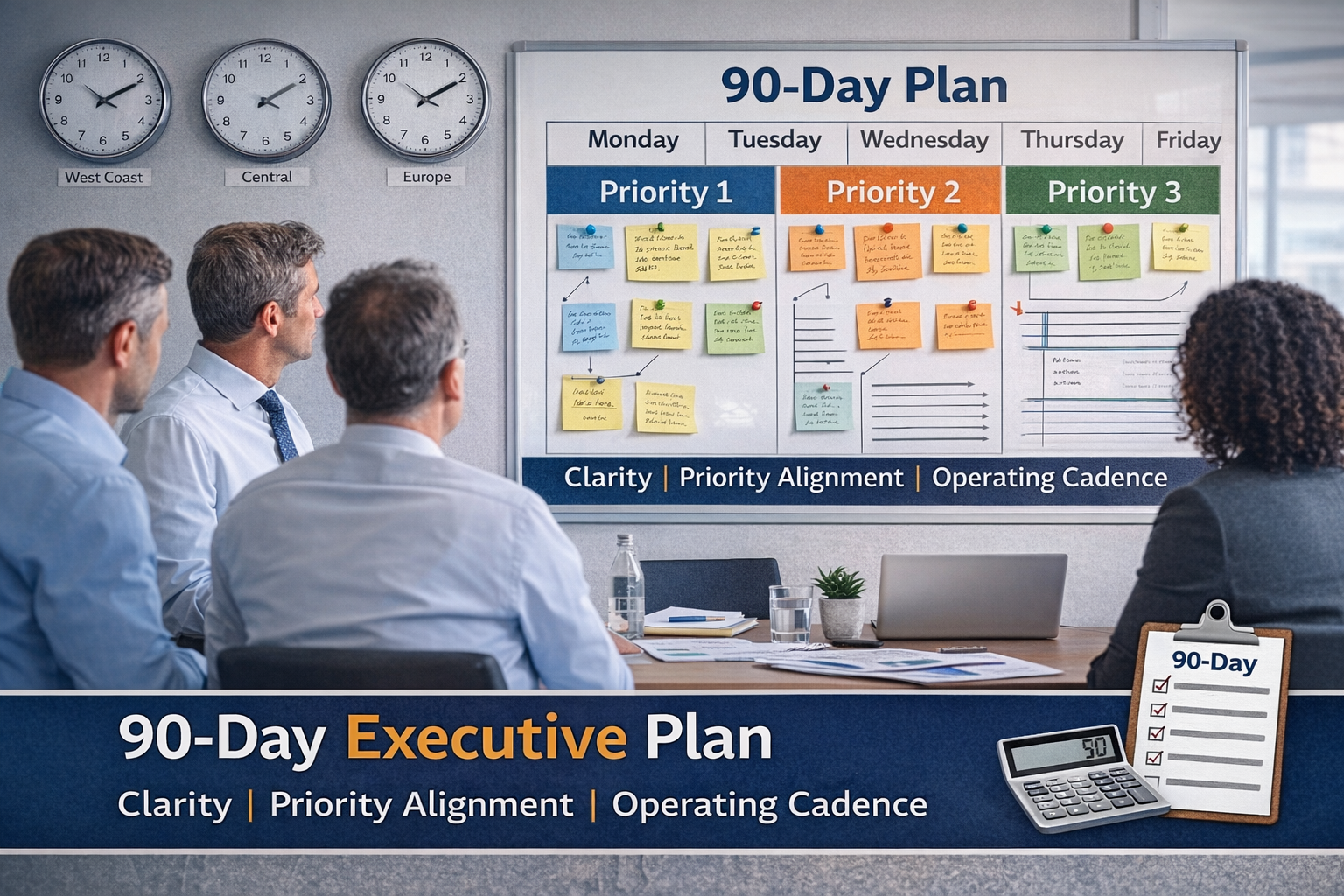
Clarity, alignment, and an execution cadence leaders can actually run
When execution becomes reactive, leaders often have the same symptoms: priorities drift, decisions don’t stick, firefighting consumes time, and performance varies across teams or sites. The issue is rarely effort—it's the absence of a clear operating focus and leadership cadence.
The 90-Day Executive Plan is a focused, leadership-led engagement designed to rapidly clarify constraints, align priorities, and install the foundational routines needed for predictable execution—without creating a long diagnostic cycle. Delivered on-site or virtually.
Schedule an Executive Conversation Request an Overview
In a short executive conversation, we’ll clarify what you’re navigating and determine whether a 90-day plan is the right starting point.
When this is the right starting point
Best for leaders who:
- Need clarity and alignment before committing to a larger transformation.
- Are seeing recurring firefighting, expediting, or missed commitments.
- Want a practical 90-day execution roadmap tied to real constraints.
- Need a leadership cadence that makes decisions stick.
- Want a structured entry point that can scale into EOS or Advisory.
Not ideal if you:
- Want a report-only assessment without intent to act.
- Are primarily looking for training or a “tool rollout.”
- Expect consultants to drive change without leadership involvement.
- Need an enterprise-wide operating model redesign immediately.
What leaders get in 90 days
1) Decision clarity and priority alignment
A clear view of constraints, trade-offs, and the few priorities that will move performance—so leadership attention is focused and consistent.
2) A leadership cadence that holds
A practical daily/weekly operating rhythm (tiered huddles, KPI reviews, escalation rules, and leader standard work) that reduces drift and firefighting.
3) A 90-day execution roadmap
A sequenced, realistic plan with owners, milestones, and measures—built around your active value streams and real operational constraints.
4) Early wins without “program theater”
Targeted improvement work to create visible momentum (often flow/capacity/quality stabilization) while leadership routines are installed.
This is not training-first. Lean and Six Sigma methods may be used where they fit, but the focus is execution reliability, decision cadence, and leadership operating behavior.
Typical structure
Weeks 1–2: Executive alignment + constraint diagnosis
- Clarify objectives, success measures, and decision priorities
- Identify constraints across flow, capacity, quality, and management routines
- Confirm the initial focus area(s) and leadership expectations
Weeks 3–8: Install cadence + execute focused improvements
- Tiered huddles / escalation rules / KPI review rhythm
- Leadership standard work and coaching routines
- Targeted improvement actions (flow, bottlenecks, quality at the source)
Weeks 9–12: Sustainment + 90-day roadmap finalized
- Stabilize routines, measures, and ownership
- Document the operating rhythm and decision cadence
- Finalize the roadmap for the next 90 days (and beyond)
Often leads to: Enterprise Operating System Transformation (for scaling across sites/value streams) or Operational Advisory (for ongoing decision support).
Why EMS Consulting Group
- Over two decades improving execution and operational performance in complex environments.
- Practical leadership routines and flow improvement—built to sustain after we leave.
- Experience in regulated operations where quality and compliance matter.
- Lean and Six Sigma methods used where they fit—without selling “tool programs.”
Next step
The right next step is a short executive conversation to clarify:
- What constraints are driving the current firefighting and variability
- Whether a 90-day plan is the right starting point
- When it makes sense to move to EOS or Advisory support
Schedule an Executive Conversation
To return to our Lean Services page, click here.