Enterprise Operating System Transformation
Create predictable execution, aligned leadership routines, and sustained capability
Senior leaders often know what they want to improve—delivery reliability, quality, throughput, margin—yet execution remains inconsistent. The issue is rarely effort. It’s the absence of a cohesive operating system that connects leadership behavior, daily management, and end-to-end flow.
The Enterprise Operating System Transformation is a leadership-led engagement (typically 6–12 months) designed to reduce firefighting, stabilize performance, and build internal capability—without adding headcount. Delivered on-site or virtually.
Who this is for: COOs, Operations, Quality, Supply Chain, and functional leaders accountable for performance, risk, and sustained results.
Schedule an Executive Conversation Request an Overview
Prefer a fast screen? In 30 minutes we’ll clarify constraints, identify high-leverage value streams, and outline a realistic 6–12 month path.
Who this is for—and who it is not
This engagement is designed for organizations where operational execution materially affects growth, margin, customer commitments, reputation, or enterprise risk—and where leadership recognizes that incremental improvement is no longer sufficient.
It is a fit if you:
- Operate across multiple functions, value streams, or sites.
- See recurring firefighting, expediting, or missed commitments.
- Need stronger alignment between strategy and day-to-day execution.
- Want internal capability ownership, not ongoing consultant dependency.
- Operate in complex or high-consequence environments (including regulated operations).
It is not a fit if you:
- Want a short-term productivity push or isolated cost-cutting project.
- Are primarily looking for training, certification, or a “tool rollout.”
- Expect consultants to drive change without active leadership involvement.
- Want a diagnostic report without intent to act and sustain change.
- Are unwilling to change operating behaviors and leadership routines.
What makes this different
- Not disconnected Kaizen events or project “waves.”
- Not classroom-first programs with limited application.
- Not consultant-owned improvements that fade after go-live.
- A practical operating system installed into leadership routines and value streams—owned by your team.
What changes for leadership
When this work is done well, leadership gains predictable execution and decision confidence—less time managing symptoms, more time running the business. Common shifts include:
- Fewer expedites, fewer surprises, fewer heroic recoveries.
- Clearer visibility into constraints, capacity, and trade-offs.
- Improved flow and lead time reliability across critical value streams.
- Quality improves because rework and variation are reduced at the source.
- Leadership routines that sustain gains (daily/weekly management system).
- Internal practitioners who can extend the operating system.
In regulated environments, this approach integrates quality, risk, documentation, and change control into the operating system—so performance improves without compromising compliance.
What is the Enterprise Operating System?
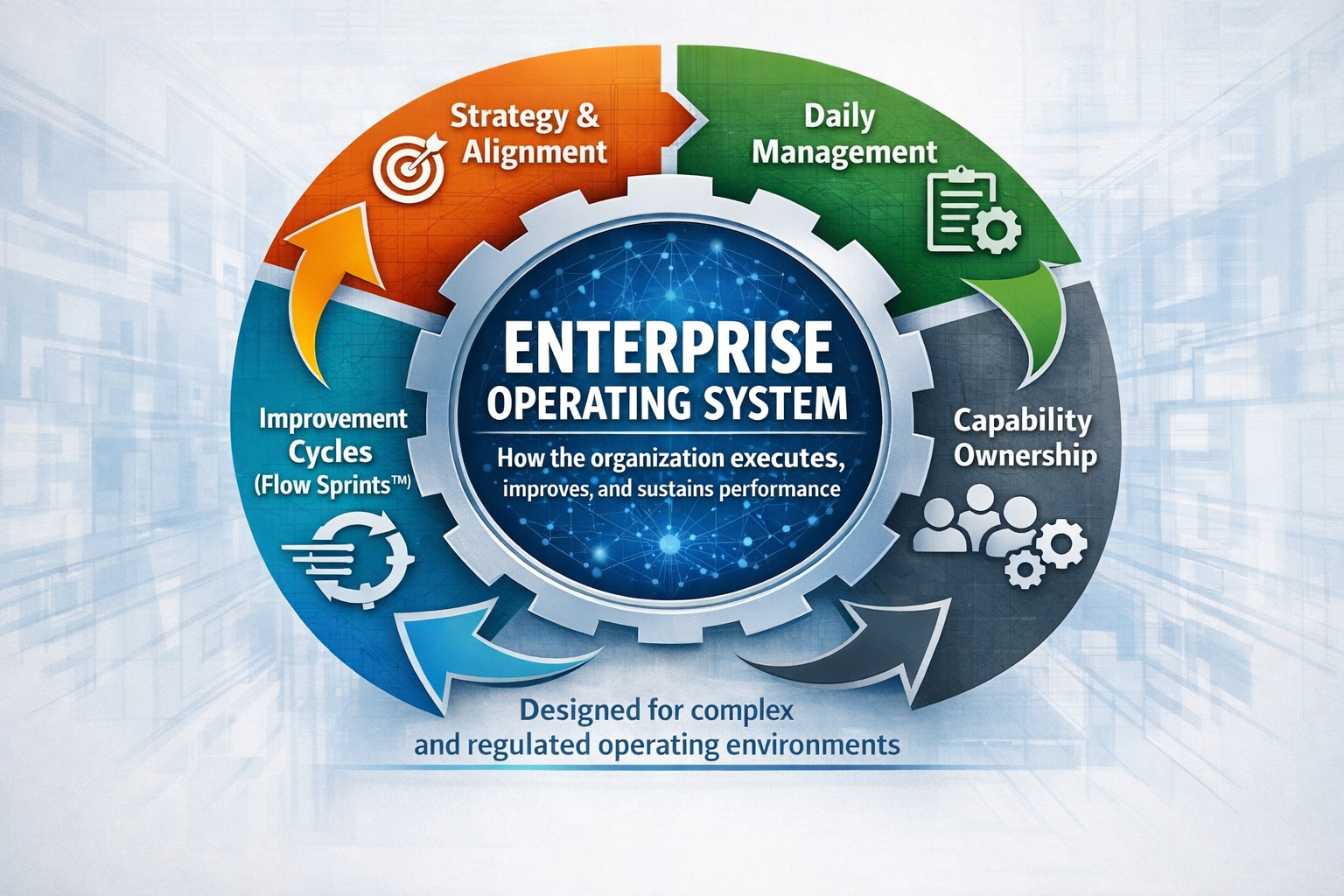
An effective enterprise operating system integrates three elements:
- Operational flow — how work moves end-to-end with minimal delay, rework, and variability (often anchored by value stream mapping and targeted Kaizen).
- Leadership routines — how performance is reviewed, issues are surfaced, and decisions are made (daily management system, tiered huddles, leadership standard work).
- Capability ownership — how the organization builds internal problem-solving and continuous improvement capability (coaching, Green/Black Belt, facilitator development).
This engagement aligns these elements into a coherent system tailored to your objectives, culture, and constraints—so results sustain and extend beyond the engagement.
How the engagement works
Each engagement is customized, but typically follows a practical sequence:
1) Executive alignment and success criteria
We clarify objectives, constraints, decision priorities, and how success will be measured. This ensures the work remains leadership-relevant and outcome-driven.
2) Diagnose the system (not just symptoms)
We identify constraints and root causes across flow, performance management, and decision routines—then prioritize the few initiatives that create meaningful improvement.
3) Execute targeted improvement cycles (Flow Sprint™)
The engine for visible wins is a focused, 4–6 week improvement cycle aimed at a specific value stream segment. This cycle typically includes diagnostic work, countermeasure design, implementation, and sustainment routines.
4) Install leadership routines (daily/weekly management system)
- Tiered huddles and escalation ladders
- Visual management and KPI review
- Leadership standard work and coaching routines
- Decision rights and governance cadence
5) Build internal capability while doing the work
Your people learn by solving real problems—not by attending abstract trainings.
- Practitioner and facilitator development
- Green and Black Belt certification (as appropriate)
- On-the-job Lean coaching tied directly to value streams
6) Sustainment from day one
- Layered audits / checks and standard work updates
- KPI health monitoring (lead time, FPY, cost of quality, stability)
- Pipeline of future improvement cycles to extend results
Typical results (tailored to your environment)
Outcomes depend on baseline performance, constraints, and leadership commitment. However, organizations commonly report improvements in:
- Lead time reliability across targeted value streams
- Reduced expediting and firefighting as flow stabilizes
- First-pass yield and stability at critical steps
- Cost of quality through reduced rework and escapes
- Leadership cadence with clearer prioritization and faster decisions
- Internal capability to sustain and extend results
Example impact (illustrative): A multi-site operations team reduced lead time variability, cut expediting, and implemented a leadership cadence that held through audit cycles—without adding headcount.
Engagement models
Each engagement is customized, but most organizations align to one of the following models. These are not predefined packages; they represent different levels of enterprise scope and leadership involvement.
Focused Deployment
- Stabilize a critical site, function, or value stream
- Install leadership routines and daily management
- Build a core internal practitioner team
Best for: organizations establishing a foundation and proving the operating system in a high-leverage area.
Multi-Value Stream Alignment
- Coordinate flow and leadership routines across multiple value streams
- Develop facilitator + Green/Black Belt capability as appropriate
- Governance cadence that supports scaling and sustainment
Best for: organizations ready to scale a consistent operating system across functions or sites.
Enterprise Advisory Partnership
- Ongoing executive decision support and governance
- Operating system refinement and expansion across the enterprise
- Internal capability buildout from practitioner to leadership
Best for: organizations undergoing significant growth, complexity, or transformation and wanting durable internal ownership.
Why EMS Consulting Group
- Over two decades of Lean consulting, coaching, and operational excellence experience.
- Practical implementation focus—results, routines, and capability (not buzzwords).
- Experience in complex environments, including regulated operations where quality and compliance matter.
- Methods that integrate value stream improvement, daily management, and leadership routines.
- Focus on sustained capability—so your team owns the operating system.
You’re not buying training or tools—you’re implementing a way of running the organization.
Next step: Schedule an executive conversation
The best way to explore fit is a short executive discussion.
In a 30-minute conversation, we will:
- Clarify current execution, flow, and quality constraints
- Identify where the highest leverage value streams are
- Discuss what a realistic 6–12 month path looks like
- Determine whether this engagement is a strong fit
Contact Us to Learn More or Schedule a Meeting
To return to our Lean Services page, click here.